2026-04-09 · 12 min
Creatine & Menopause: the complete guide
Written by Het Zesty team · Based on peer-reviewed research, not intended as medical advice
Creatine is one of the most studied supplements in the world, with over 500 peer-reviewed studies. Yet most women don't know that it becomes most relevant during menopause. Women have 70-80% lower creatine reserves than men (Smith-Ryan et al., 2021), and that gap grows as oestrogen declines.
This is the complete guide: what creatine is, why it matters during menopause, what the research says, and how to use it.
What is creatine?
Creatine is a substance your body naturally produces via the liver, kidneys, and pancreas. You also get it through food, especially meat and fish. It's stored in your muscles (~95%) and your brain (~5%), where it serves as a rapid energy source for your cells through the ATP system.
It's not a steroid, not a hormone, and not a stimulant. It's an amino acid derivative that your body makes and uses every single day.
Why women produce less creatine
Women produce significantly less creatine than men. Smith-Ryan et al. (2021) report that women have 70-80% lower endogenous creatine reserves. This is partly due to lower muscle mass, but also due to hormonal differences.
Animal models show that AGAT (arginine-glycine amidinotransferase), the rate-limiting enzyme in creatine synthesis, is influenced by oestrogen and testosterone levels (Ellison et al., 2025). This means that hormonal shifts directly affect how much creatine your body can produce.
The oestrogen-creatine connection
During perimenopause and menopause, oestrogen declines. This affects not only well-known symptoms like hot flashes and mood swings, but also creatine metabolism.
Research shows that changes in hormone levels affect endogenous creatine synthesis, creatine transport, creatine kinase activity, and bioavailability (Ellison et al., 2025). In simpler terms: as oestrogen drops, your body makes less creatine, transports it less efficiently, and uses it less effectively.
The result is a growing deficit at the very moment your brain and muscles need it most.
Creatine and brain fog
About 5% of your body's creatine is in your brain, where it serves as a rapid energy source for neurons. Dechent et al. (1999) showed with MRI scans that oral creatine supplementation measurably increases creatine concentration in the brain.
Rae et al. (2003) found in a double-blind, placebo-controlled study that creatine significantly improved working memory and abstract reasoning. A meta-analysis by Xu et al. (2024) confirms improvements in memory, attention, and processing speed, with the strongest effects in women and individuals under stress.
For women in menopause who struggle with brain fog, this is relevant: ongoing research links the cognitive decline to falling creatine levels in the brain. What that means in practice for any one person can vary.
Read more: Creatine benefits for women: what the research says
Creatine and muscle loss
Women lose an average of 3-8% of muscle mass per decade after age 40, and this accelerates after menopause (sarcopenia). Chilibeck et al. (2023) conducted a two-year randomized controlled trial in postmenopausal women. The group that took creatine combined with resistance training retained more muscle mass and bone density than the placebo group.
Smith-Ryan et al. (2021) conclude that creatine is effective for maintaining skeletal muscle mass and function in postmenopausal women, especially at higher dosages (0.3 g/kg/day) combined with training.
Creatine and fatigue
Creatine plays a central role in the ATP system. When your reserves drop due to menopause, stress, or insufficient dietary intake, your cellular energy production drops too.
Supplementation restores those reserves. The effect builds over 2-4 weeks as your muscles and brain become saturated again. The "constant tiredness" that many women experience during menopause is linked to this energy deficit at the cellular level.
Creatine and bone health
Bone loss (osteoporosis) is a common consequence of declining oestrogen after menopause. The two-year study by Chilibeck et al. (2023) showed that creatine combined with resistance training maintained femoral neck bone mineral density better than training alone.
This makes creatine one of the few supplements where research points to both muscle and bone-related effects in postmenopausal women, in each case combined with strength training.
Creatine and mood
A recent randomized controlled trial in 36 perimenopausal and postmenopausal women found that eight weeks of creatine supplementation improved reaction time and reduced the severity of mood swings (Impact of creatine supplementation on menopausal women, 2025).
Smith-Ryan et al. (2021) report that both preclinical and clinical research points to positive effects of creatine on mood and cognition, possibly by restoring the energy balance in the brain.
The role of supporting ingredients
Creatine doesn't work in isolation. Several ingredients enhance its effect or address related menopause symptoms:
- Turmeric (curcumin): has anti-inflammatory properties relevant to menopause-related joint discomfort (Hewlings & Kalman, 2017)
- Ginger: supports digestion and has anti-inflammatory properties
- Piperine (black pepper extract): increases curcumin bioavailability by 2,000% (Shoba et al., 1998)
- Electrolytes: support creatine transport to muscle and brain cells
- Vitamin C: essential for collagen synthesis, relevant to skin changes after menopause
Dosage: why 10g and not 5g
The standard dose of 3-5g per day is enough to maintain muscle creatine levels. But ~95% of your body's creatine is in your muscles. Your brain contains the remaining ~5%, and that's exactly what menopause depletes.
Researchers studying cognitive benefits in women use 10g or more to also reach the brain (Dechent et al., 1999; Smith-Ryan et al., 2021). At 10g/day, your creatine levels reach saturation in about 2 weeks, faster than the ~28 days at 3g/day.
Do you need a loading phase?
No. A 20g per day loading phase is unnecessary for women in menopause, and usually not a good idea. With a steady 10g per day, your creatine stores reach saturation in about 2 weeks. That is faster than the 28 days you need at 3 to 5g, without the stomach issues a loading protocol often causes.
The loading protocol (20g per day, split over 4 doses, for 5 to 7 days) comes from research on young athletes in the 1990s. The goal was to measure training effects within a study week. That is a different goal than yours.
For cognitive research goals and menopause support, the logic is different:
- 10g per day saturates both your muscles and part of your brain. Your muscles take up about 95% of your body's creatine. The remaining 5% in your brain is exactly what menopause puts under pressure. Researchers measuring cognitive effects in women use 10g or more to reach that brain saturation.
- A steady dose is just as effective in the long run. Forbes and Candow (2022) compared loading protocols with steady daily doses and found no difference in end result, only a difference in how fast you get there.
- Lower chance of side effects. High doses all at once cause stomach issues, cramps, and water retention outside the muscle more often. A steady daily dose stays under that threshold.
With Zesty you get 10g of creatine per shot. One shot, every morning, no loading, no measuring.
Safety and side effects
Creatine is safe. The ISSN position stand (Kreider et al., 2017) concludes that supplementation up to 30g/day for 5 years is safe and well-tolerated in healthy individuals. No effect on kidneys, hormones, or hair loss in healthy women.
The most common question is about weight gain: that's 1-2 kg of water in the muscles, not fat. It stabilizes after 2 weeks.
Read more: Creatine side effects in women: what does the research say?
How Zesty combines this in a daily shot
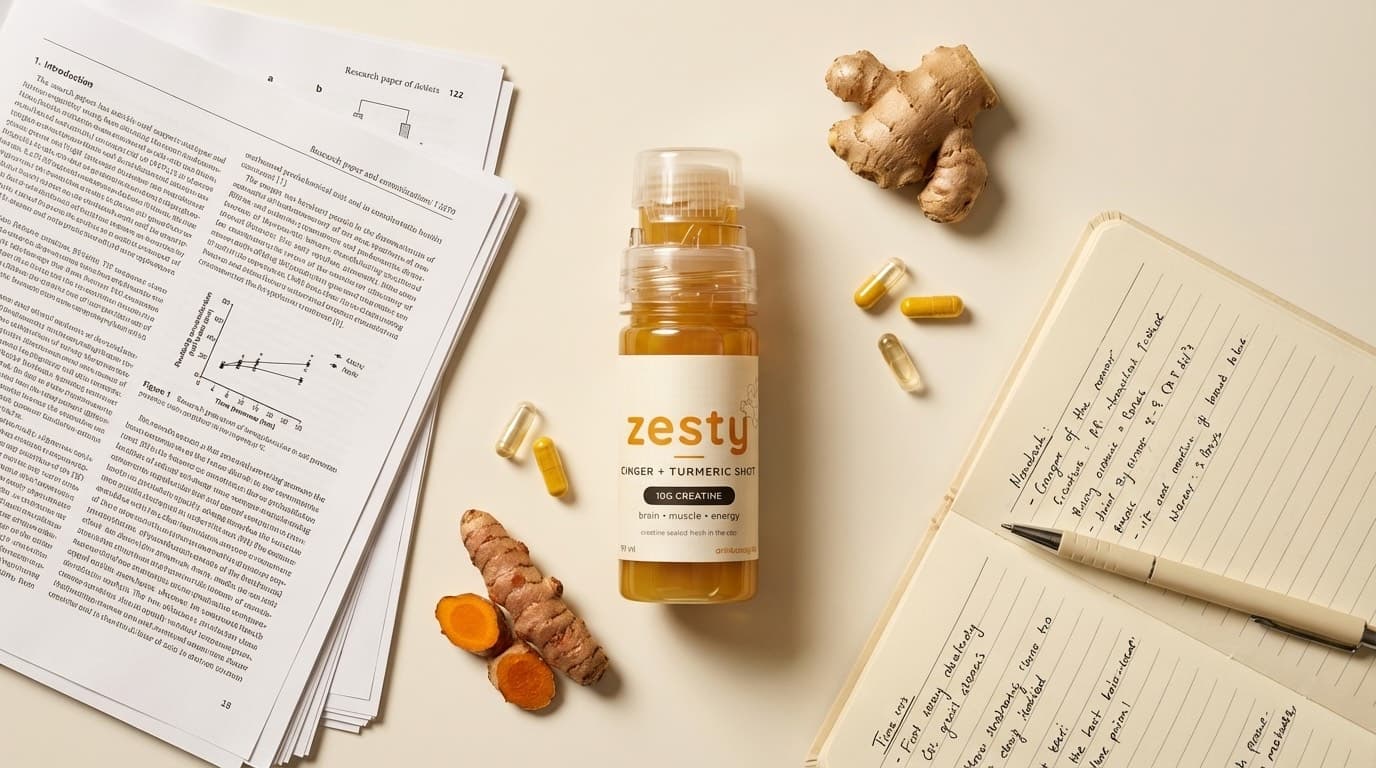
Zesty delivers 10g creatine monohydrate per shot, sealed in the cap to guarantee stability (creatine breaks down in liquid). The cold-pressed shot also contains ginger, turmeric with piperine, electrolytes, and vitamin C.
One shot, every morning. No powder to measure, no shaker, no tasteless capsules. Twist, press, shake, drink.
How does creatine fit into a broader supplement plan?
Creatine is the most evidence-backed supplement for women in menopause, but it doesn't stand alone. A practical starter combination:
- Creatine (10g/day): cognition, energy, muscles, bones
- Vitamin D3 (1,000-2,000 IU/day): bones, immune system
- Magnesium (200-400 mg/day): sleep, stress, muscle tension
Read more: Best supplements for women in menopause
References
- Smith-Ryan, A.E. et al. (2021). Creatine Supplementation in Women's Health: A Lifespan Perspective. Nutrients, 13(3), 877.
- Ellison, C. et al. (2025). Creatine in women's health: bridging the gap from menstruation through pregnancy to menopause. JISSN.
- Chilibeck, P.D. et al. (2023). A 2-yr RCT on Creatine Supplementation during Exercise for Postmenopausal Bone Health. MSSE, 55(10), 1750-1760.
- Dechent, P. et al. (1999). Increase of total creatine in human brain after oral supplementation. AJP, 277(3), R698-704.
- Rae, C. et al. (2003). Oral creatine monohydrate supplementation improves brain performance. Proceedings of the Royal Society B, 270(1529), 2147-2150.
- Xu, Y. et al. (2024). The effects of creatine supplementation on cognitive function in adults. Frontiers in Nutrition, 11, 1424972.
- Kreider, R.B. et al. (2017). ISSN position stand: safety and efficacy of creatine supplementation. JISSN, 14(18).
- Brosnan, J.T. & Brosnan, M.E. (2007). Creatine: endogenous metabolite, dietary, and therapeutic supplement. Annual Review of Nutrition, 27, 241-261.
- Hewlings, S.J. & Kalman, D.S. (2017). Curcumin: A Review of Its Effects on Human Health. Foods, 6(10), 92.
- Shoba, G. et al. (1998). Influence of piperine on the pharmacokinetics of curcumin. Planta Medica, 64(4), 353-356.
- Impact of creatine supplementation on menopausal women's body composition, cognition, estrogen, strength, and sleep (2025).
- Dr. Stacy Sims: Why Active Women Need Creatine